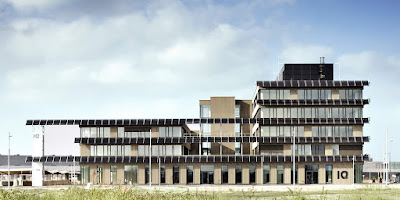
Finally a project I´m allowed to publish officially: EXPOWEBSITE

Architecture, Design, Research & Technologie by Manfred Hermann


The museum is seen as an urban connector and destination point, where art should be able to flow out of the building and the city should be able to flow inside. Through an all-time open atrium
where visitors are welcomed to engage in artistic discourse, attend music, cinematic and arts festivals, or maybe just hang out on their way elsewhere, the museum becomes a hybrid space where different kinds of people can meet and unexpected events can occur.


The main aim of the gradient scale project was to experiment and to scrutinize the concept of scale in architecture. In general the concept of scale is considered to be a very rigid idea, following rules that seem to be unbendable. To understand plans or models, architects and contractors are bounded to a formula, or etiquette of communication, the scale. The gradient scale project background is a thesis, which formulates the idea of non-sequential scalar growth. The entire project is an experimental digital scape, produced as a presentation platform for the projects of SPAN (Matias del Campo & Sandra Manninger) at the AustriArchitecture exhibition in the Zumtobel Lightforum in Vienna, Austria.


The main theoretical background, and the digital fabrication means applied in this project are interlocked with each other. Certain Issues connected to digital production methods were explored using a 3axis-milling machine. The Software Surfcam, which is used to calculate the NC files for the milling machine gives the architect a powerful tool to examine different surface patterns which emerge from the isoparms created in the MAYA model. By consciously manipulating the isoparms direction the final, milled result can be severely formed, as well as by choosing different mill bits and variating the stepsizes of the milling path. There is a wide range of possible applications in architecture for pattering. The jagging and rippling of the surface can be used to create reinforcement ribs in the panel’s structure, the objects surface can get a defined direction.


By representing the raptured virtual body through stripes of anti-mobile frequence net on the outside and an complete art-nouvo stucco profile wrap on the interior forming an unique exhibition space and bar.
Date: 2004
Title: Stucco Frequence Cocoon
Client: Architektur Zentrum Kärnten
Budget: 5000 €
Materials provided by industry partner of comeption host:
Anti Mobile Frequnce Net
Selection of Stucco Profiles